|
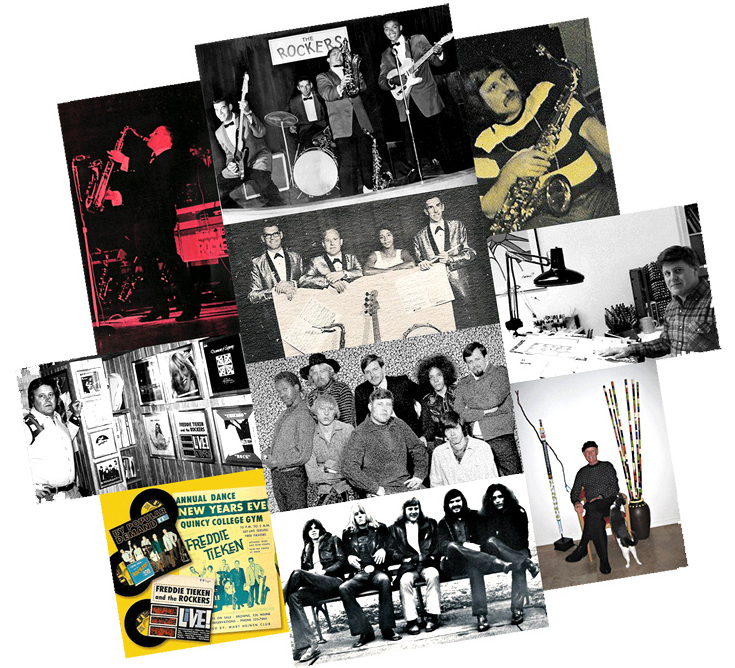
For more than five decades, Freddie Tieken's life has
centered
around music and design. He has been a musician and vocalist,
songwriter and arranger, recording engineer and producer, artist
manager,
music publisher and concert promoter. He has owned and
operated three
recording studios. For 16 years, he fronted his
own bands, playing over
3,500 live gigs and spending
thousands of hours in recording sessions.
Freddie or Fred, as he is known today, was creative
director at a leading Chicago design agency before starting his own design
and marketing firm. He has received more than 200 national and
international awards in the fields of design, illustration, art direction,
marketing and advertising. He has been featured in Graphic Design: USA
magazine as an International Top 50 Art Director and has appeared in
Who's
Who of Outstanding Americans.
A lot of misinformation has appeared on the Internet and
in various print media over the last several years concerning Freddie
Tieken and his bands. The following narrative is meant to once and for all
set the record straight, in his own words, for anyone who might be
interested.
I was born Frederick Earl Tieken in 1935 during the
great depression. My birthplace was a one-room shack in the Mississippi
river town of Meyer, Illinois, population 100. My father Dale Tieken
worked as a welder, helping to build the Meyer-Canton dam for the WPA.
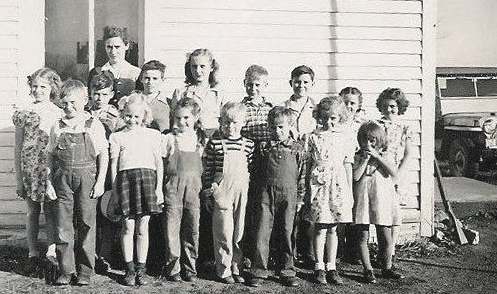
Meyer Grade School student body with teacher, circa 1945. Freddie is fifth
from left in back row of students.
|
|
 |
|
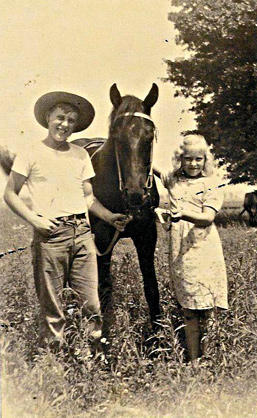
Freddie and sister
Janet with Thunder
around 1948.
|
When the WPA job ended, we moved to the big city
(population 40,000) of Quincy, Illinois, about 20 miles away where my dad
found employment as a welder. Eventually he saved up enough money to quit
the welding job and buy some farm machinery. We moved to a farm near Meyer
where my dad was a share-crop farmer on 300 acres of rich Mississippi
river bottom land. For the next few years, I attended a one-room school in
Meyer.

I spent a couple of summers across the river in Canton,
Missouri with my Grandma Lillie and Aunt Joy Caldwell. Grandma's apartment
was above the Canton Cinema and every Saturday night we would sit by the
open window and look down on the lines of people gathering for the movies.
On Saturday afternoon, Grandma would give me a quarter to go to the
matinee double feature, usually featuring Hopalong Cassidy, Lash La Rue or
Gene Autry. I could sit through those double features two or three times.
Next door to the theater was a honkytonk tavern and on
weekends we would sit at our open window and listen to the sounds of
hillbilly music and people having fun pouring out of the tavern while we
ate our peanut butter and jelly sandwiches. The noise never got too loud
or raucous for my Grandma.
What wonderful summers those were! It might as well have
been Times Square. When I look back now I realize that this is where I
developed my love of music, theaters, and the whole notion of people
having a good time and
being entertained.
At about that same time my parents managed to save
twenty-five dollars to buy me a clarinet. I'll never forget the first time
I picked up that clarinet. By the end of the first day, I could play
"Don't Fence Me In" and "Twelfth Street Rag". I didn't know what sheet
music was, I just listened to the radio and any old 78 RPM records I could
get my hands on.
I also developed quite an interest in drawing, creating
my own comic books, posters and ads for my make-believe orchestra and
movie theater. I didn't realize it at the time, but we were very poor and
I remember my parents having just enough money to buy me a dozen sheets of
typing paper every Saturday at the corner store. Before the week was out,
I'd have every square inch of that paper covered with my drawings and
paintings. My mom Tina was always my biggest supporter and she saved a lot
of my early artwork.
Some of my fondest memories as I approached my high
school years are the Sunday afternoons we spent at Grandma and Grandpa
Tieken's sprawling old farmhouse. After a huge dinner, we would all gather
in the parlor where Dad's entire family would rock out on the piano, banjo
and juice harp with lots of vocal harmony and yours truly on the clarinet.
Another favorite activity on those Sunday afternoons was a ride on Duke or
Barney, my Grandpa's plow horses.
My mom always encouraged me to play my clarinet at
school and church events. She would drive me to all the local dances and
by age twelve I was "sitting in" with the likes of Bo Shipe, one of the
area's most
popular bandleaders.

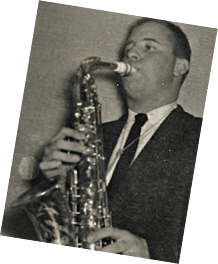
Eventually I was lucky enough to get
my first saxophone.
I was in love! It was
so much more expressive than
the clarinet. I also
was fortunate to
have a young high school music
teacher, Otto Warner, who
turned
me on to Duke Ellington and Count
Basie. I was hooked. I soon
formed
a little group with other high school musicians and called it
Freddie
Tieken's Four Stars. We performed
in the gymnasium during
lunch
hour and at
pep rallies.
 |
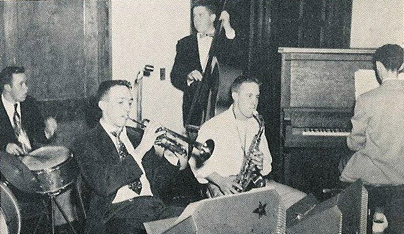
Freddie Tieken with his Four Stars, 1952. From left: Richard Spalding,
Dick Austin, Don Neil, Freddie and
Joe Conover.
|
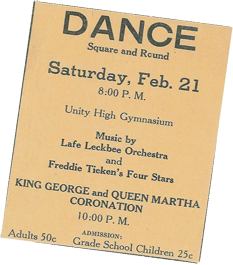
Somehow I convinced Lafe Leckbee, a square dance
bandleader, to let my group play during his intermissions every weekend at
the Lorraine, Illinois town hall. Before long, Leaf was gone and we had
the gig. At five dollars each per night, I guess you could say this was my
first professional gig.
Every summer during my high school years I was expected
to plow, plant and be a good dirt farmer. I hated every minute of it and
my dad considered me very lazy, but every minute I wasn't working in the
fields, I was busy drawing and
playing my saxophone.
Sometimes I would work for the neighbors, bailing hay
for $5.00 a day. It always seemed like it was 100° from dawn to dark,
seven days a week with so much chaff in the air you could hardly breathe.
And all the while those giant Mississippi River bottom mosquitoes were
trying to suck all the blood out of you. The good part was that one summer
I saved enough money to buy a
saddle for my horse Thunder.
The absolute worst job I ever had though was working at
a gas station as an attendant/tire changer on the weekend graveyard shift.
When truckers called in with flat tires, I would take the wrecker out to
what seemed like the middle of nowhere and fix flats and change tires on
the big rigs. It seemed like it was always in the middle of an ice storm
too. But at $1.00 an hour, it was really good money back then. I guess
these jobs were good for me because they really motivated me want to make
a living from art and music.

Meyer, Illinois sits on the Mississippi River directly
across and a short ferry ride from Canton, Missouri, home of Culver
Stockton College. Some really cool jazz cats from Chicago and New York
were students at the college and on Sunday afternoons the Meyer Tavern -
the only place of business in Meyer - was the place to be since Missouri
was dry on Sunday. These guys would bring their instruments and play bebop
all day long. The audience was mostly farmers, fishermen and hunters with
a few hip college students thrown into the mix. As a teen I would come in
from the farm to hear the music and it was like going to
heaven. It was
unbelievable!

By the mid-1950s I had graduated from high school and
was playing a lot -- bars, proms, parties and jamming with anyone who would
let me sit in. My musical tastes were widening. I loved the blues and was
really into the Memphis sound like Rufus & Carla Thomas and Otis Redding.
The clubs up and down the river were jumping, especially the Terrace Room
at the Hotel Elkton in Quincy.
Johnny, the Terrace Room manager, would hire these
fabulous black jazz groups from all over the country. I'm talking about
smokin', rockin' bands like Illinois Jacquette, Hiawatha & his Musical
Tribe, and Cozy Eggleston since Quincy was a convenient layover between
Chicago and the strip clubs of East St. Louis. Every Sunday afternoon
brought live jam sessions and I can't believe I had the nerve to get up
there and play with those monsters. They tolerated me and did I learn a
lot.
It was so.exciting!
I had formed a group called The Freddie Tieken Combo and
as my reputation began to grow, I was able to get the cream of the crop of
area musicians
for
my band.
| |
 |
|
| |
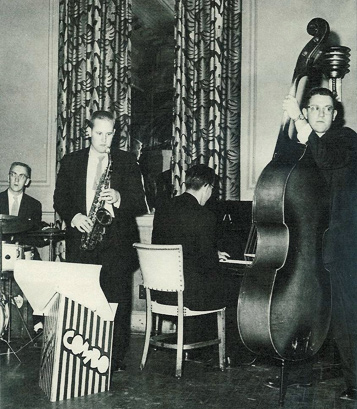
The Freddie Tieken
Combo at the Mark Twain Hotel ballroom, Hannibal, Mo. In the early
1950s. From left: Skip Johnson, Freddie, Dale Schroeder, Don Neil. |
|
It's hard to imagine now that I did all this while
holding down a day gig. I guess that's why I was eventually fired. I had
started straight out of high school at Gardner Denver in Quincy, Illinois
as an apprentice mechanical draftsman. My football coach Mr. Nelson, who
was also my drafting teacher, got me the job. I learned to do perspective
drawings and pen-and-ink exploded views and eventually became an
illustrator and designer for the automation of assembly lines in the
Detroit automotive industry. Among other things, I helped design the
machine that put the big chrome strips on the sides of Ford Fairlanes as
they rolled down the line.
My automotive design work meant frequent trips to
Detroit where I enjoyed going downtown to Baker's Keyboard Lounge to hear
all the big names in jazz. Between the travel schedule and too many late
nights with my band, I became extremely burnt out. That's when I started
neglecting my work and finally
got the.axe.
I had been driving about 40 miles to Keokuk, Iowa every
Wednesday night to play with a band, The Mood Notes, that my sister Janet
had told me about. It paid twelve dollars a night and I liked the gig
because they rocked. The band was about to break up and I asked the bass
player, Mark Millspaugh, to join a band I was putting together. The year
was 1955.
|
I think when rock n' roll came along, it freaked the
board members of the AFM out. They felt really threatened by rock n' roll
and rightfully so.
These guys all had boring, old-school bands of their own
and, with an inside track on where all the best gigs were, they kept them
for themselves. When the clubs, schools and concert hall owners starting
requesting Freddie Tieken & the Rockers, they were pressured not to hire
us because we weren't union. So we joined the union and that's when the
trouble
really.began.
They watched me like hawks, just waiting for me to break
a union rule. And that wasn't a hard thing to do. I never was much on
paper work, so I was always paying fines for filing my contracts late or
not at all. I think the filing fee was $5.00 and the fine was $25.00.
Anyway, their tactics didn't work because we were playing all the gigs and
the old farts from the union were
sitting home.
Ironically, the secretary of the union local in Quincy,
Carl Landrum, owned a music store and gave lessons. My parents had taken
me there when I first started playing clarinet in grade school. After
about three lessons he told my parents that I should give up music, that I
just didn't have what it takes. It must have really gotten under his skin
to see me years later taking gigs
away from him.
Another music store eventually opened just down the
street. Its owner Gus Rieckhoff had experienced his own problems with the
union. Consequently, Gus is kind of a renegade and has always enjoyed
having the likes of me and my brother Dennis buying equipment and supplies
from.him.
Gus was smart enough to hire Gail, the person who
eventually would become my wife. She was a sax teacher and also worked
sales out front. Gail was an award-winning alto saxophonist whose
specialty was sight reading. She would always select my reeds for me. She
says we first met when I poked my head into the instruction room and made
fun of her teaching a young student to read music, but I don't remember
that. Anyway, I always thought she was something else when I used to see
her at the T'N'T Raceway gigs. I also remember playing at her high school
when she
was crowned Miss Sweetheart.
Years later after we were married and Gail started her
talent agency, she had to go before Carl Landrum to apply for her AFM
license. I can't believe he gave it to her but she says she convinced him
that she would bring money into the union local by making sure contracts
were filed on all the dates she booked. And she did.
One time we were playing Club Laurel in Chicago when
these mafia types came in, walked up to us and said, "We'll be back in
five minutes - have all your union cards on the table when we get back."
Luckily we were all standing members, and I say lucky because I had heard
that in Chicago they would set fire to non-union musicians' cars. That's
about as close to a totalitarian regime as I ever want to get. To this day, I have never received one dime in benefits
from the AFM even though I paid my dues and made them lots of money for
years and years. |

One Sunday afternoon shortly after that, Mark and I were
playing at a black VFW jam session in Quincy and that's when I first met
Byron "Wild Child" Gipson. He had just come off the road with Little
Richard. We hit it off so well that we decided that same night to head
over to The Barn, a popular, local nightclub, and we set up our equipment.
We played a couple of tunes for the owner and were hired on-the-spot.
That's the night that Freddie Tieken & The Rockers was born. The original
band featured Mark Millspaugh on upright bass, Ron Davis on drums, Wild
Child on vocals, piano and guitar and myself on sax
and vocals. The gig at The Barn lasted well over two years and the band drew
record-breaking
crowds night after night.
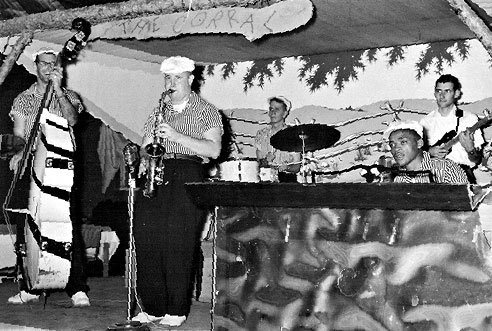
If you came of age in the Midwest in the late 50s or
early 60s, the chances are pretty good that you danced, strolled,
bugalooed and, for the most part, partied the nights away with one of the
popular rock'n'roll bands of that time period.
Let's face it, in those days there wasn't a rock band on
every street corner, but there was a handful of bands out there making
their place in Midwestern legend. One of those bands was Freddie Tieken &
the Rockers and we earned our reputation by traveling through the
cornfields and playing every gig we could. Night after night, we would
pull up and the Rockers would roll out for another night of raucous, high
intensity fun.

Mark had his upright bass painted with black and white
stripes - what a showman! He would spin it around as I grabbed it. The
entire band would fall to their knees and backs and spin around on the
floor. It was sheer energy and we loved every minute of it. The crazier we
got, the more the crowd responded. One night I failed to grab the spinning
bass at the right moment and it fell off the stage and ended up a pile of
splinters. That's when Mark switched to Fender electric bass.
I would jump up and run along the top of the bar while
playing my sax. Then I would jump back down and continue playing as I ran
through the crowd. A long line would develop behind me and I'd lead
everyone out the front door while still wailing away on my sax. We would
proceed into neighboring clubs where even longer lines would form, so by
the time I returned to the club where we were playing, the crowd was twice
as large. I get exhausted just thinking about it now.
|
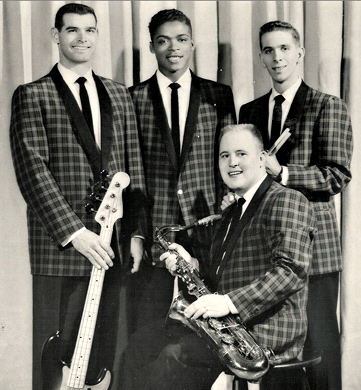
Mark Millspaugh and I used to head to East St. Louis to
catch the sounds at the all-black clubs where the music would pour out
onto the downtown streets. One night within one block we heard T-Bone
Walker, Bobby Blue Bland and my idols, Ike & Tina Turner. |
Although our fans were color blind, others were not. I'm
proud that we were one of the first integrated rock'n'roll bands but back
then it made things difficult. Wild Child couldn't even stay in the same
hotels as us. There was an area in each town we went where he would know
people to stay with. All the big stars like Annette Funicello and Frankie
Avalon that we did the TV shows with -- we certainly looked different than
them.
| |
 |
|
|
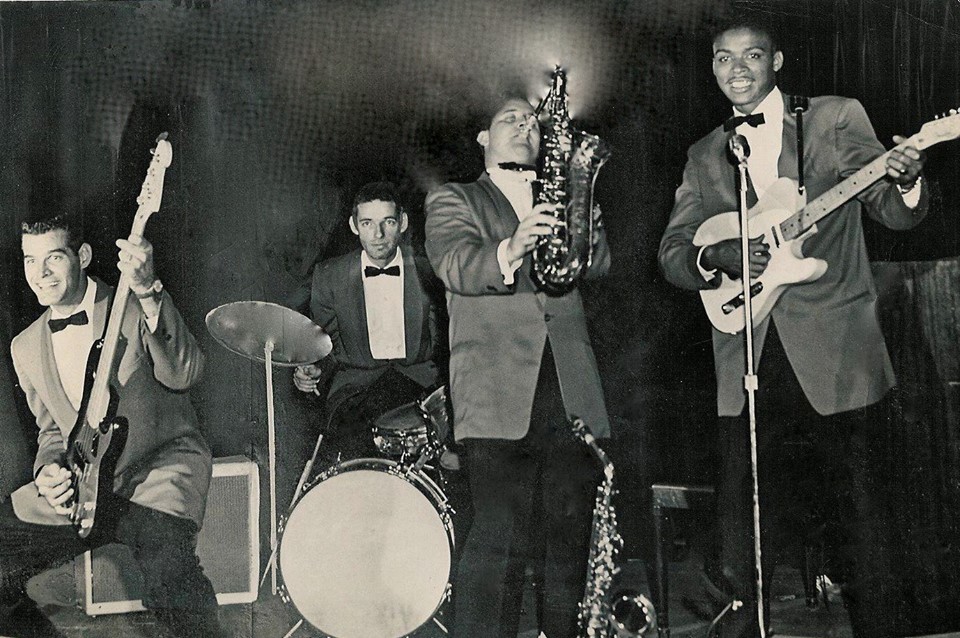
Freddie Tieken & the Rockers at the
Terrace Room, Hotel Elkton, Quincy, Ill. From left: Mark Millspaugh,
Clete Webster, Freddie and Wild Child Gipson. |
|
My only memories of Cicero, Illinois involve Wild Child
holding off a bunch of rednecks with a gun while I went to get the car. I
guess they didn't care much for blacks in Cicero. It seems scarier than
hell when I look back on it, but we just took things like that in stride
and went on to the next gig.

It seems like anything that could happen, happened to us
in those days. I remember one night - it was our first night at a
nightclub in Rock Island, Illinois. We were just getting ready to start
our first set when the police came in, pulled our drummer off the stage
and hauled him off to jail. He had apparently forgotten to pay his hotel
bill in Quincy earlier that day. I guess the fact that he had left by the
fire escape didn't help his case.
And Wild Child, he was quite a ladies' man. He seemed to
have a different woman every night. He would sleep all day and play all
night.
One night at Harold's Club in Peoria, Illinois we were
sitting around during intermission when a well dressed guy came up and
introduced himself. We talked music and instruments and he invited us out
for dinner at a nice restaurant. He didn't have to ask us twice - a day
off from road food sounded really good. The next day we piled into his
very nice car and dined with non other than Leo Fender, founder of Fender
guitars. What a great guy he was. He came back later and stayed all night
listening to our group.
Speaking of Harold's Club, we would play from 9 pm to 4
am every night and couldn't wait for the next set. What a fun place that
was. During intermission, this young comedian would do his standup
routine. Years later I learned that the young comedian was Richard Pryor.
During this same time, Freddie Tieken & the Rockers
released a single on Hit Records, "Sittin' Here Cryin'" backed by "Uncle
John," both written by Wild Child. The single reached number 24 on the
Billboard R&B chart. Recorded at Boulevard Studios in Chicago, John
Moorman, a good friend of mine, played guitar and sponsored the session.
The single was later re-released on both the Laurie and Astra labels.
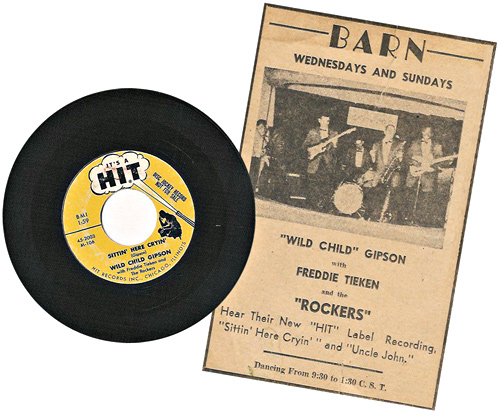
At that same session, Herb Gronaeur, our booking agent,
and I put together an instrumental called Big Bad Train that was later
released by Tommy Dorsey.
| |
 |
|
|
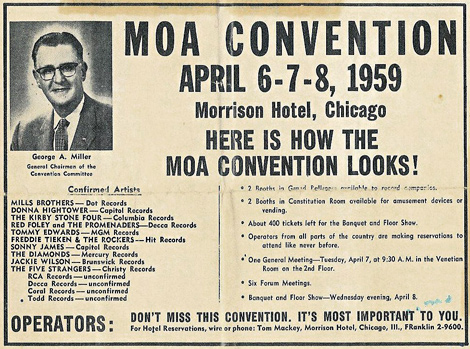
Ad for Music Operators Convention, Chicago, Ill. Check out the artists
appearing at the show. |
|
Sittin' Here Cryin' received national exposure and we
found ourselves touring constantly, lip synching our tunes for televised
teen shows throughout the country on the same bill with Connie Francis,
Jackie Wilson, Pat Boone, The Diamonds and The Big Bopper to name a few.
We were part of Dick Clark's Caravan of Stars and thousands of people
would show up to these shows.
Something really funny happened at one of the TV teen
hops we played. We had been on the road all night and finally arrived at
the TV studio just minutes before we were to lip sync our new single on
live TV. We came in the back loading dock area while The Big Bopper was
performing his hit, Chantilly Lace. There was a large screen that he sang
in front of and it was backlit with a projector. I was thoroughly burnt
out from traveling all night and was wondering around what I thought was
backstage. I had no idea that my silhouetted image was dancing around The
Big Bopper as he performed. We thought it was pretty funny but the
producer didn't laugh. |
One nice thing about doing TV shows in Chicago was that
everywhere we went people knew who we were. There were only a couple of
local TV stations in Chicago back then. Consequently, the doormen at all
the big nightclubs would recognize us and let us in. I remember one night
at the Blackstone Hotel Lounge, the room was very smoky and the stage was
dimly lit but I could see the silhouettes of some very interesting looking
musicians. I turned to Wild Child and said, "Who is that trumpet player
with his back turned to the audience?" Well, Wild Child informed me that
was Miles Davis on trumpet and John Coltrane on sax. I really didn't have
a clue how cool that was at the time. I was still a country boy just
getting his feet wet in the ultracool world of jazz.
What great times those were. Wild Child Gipson was one
of the best friends I've ever had. He was a true professional, a real
talent and a tremendous person.
|

It seemed like everywhere we went, there was Chuck
Berry.
On our way to St. Louis from Quincy the band would stop
in at the Southern Air, a restaurant Chuck owned in Wentzville. Chuck
would be there, all by himself, sitting at the counter.
When the Rockers played a week at Harold's Club in
Peoria, there was Chuck sitting at the bar, all by himself, with his big
yellow Cadillac convertible parked outside.
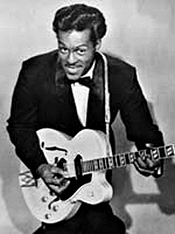
Gail booked bands at his club in Wentzville for a while.
His assistant who handled the bookings for the club always referred to him
as "Mr. Berry." One of the bands Gail booked made the unfortunate mistake
of introducing a cover of Elvis Presley's Blue Suede Shoes with the
statement, "Now we're going to play a song by the king of rock n' roll."
The band was immediately fired without pay and, although Gail offered an
apology from the band and attempted to collect their pay, Chuck's feelings
must have been sufficiently hurt that he felt justified in his actions.
Needless to say, Gail quit working with "Mr. Berry" after that.
In all the years that I ran into the guy throughout the
Midwest, I never heard him say two words to anyone. |
As they say, all good things must come to an end, and
this was true of the original Rockers as we eventually went our separate
ways.
I was looking for a day gig to get me by until I could
get a band back together when I got one of the biggest breaks of my life.
Bob Middendorf of Creative Printers in Quincy, Illinois hired me on as a
commercial artist. That's what they called graphic designers back in those
days. I'm not even sure why he hired me. My portfolio at this time pretty
much consisted of rock n' roll posters along with the technical drawings I
had done for automotive assembly design. For whatever reason, Bob took me
under his wing and became my mentor. He taught me everything he knew about
graphic design and printing. After I'd been with him for a
while, he made me a partner in Creative Advertising.
|

T'N'T
Raceways track
announcer Paul
Butler presenting the
Point Championship
trophies to Freddie
Tieken in 1962.
|
|
It was about this same time that I got interested in
kart racing. I would travel all over the country with my dad and brother
Dennis to race on different tracks. Dennis also raced and my dad was our
mechanic. Sometimes I would drive all night after a gig with my band in
order to run a 100-lap enduro the next day. Gus Traeder opened T'N'T
Raceways in West Quincy, Missouri where I became Point Champion and won
the Single Engine National Championship.
| |
 |
|
| |
National Karting Championship trophy winners, West Quincy, Mo.
Freddie,
kneeling, fourth from left. |
|
It wasn't unusual for me to race all day at T'N'T and
then go back that night with the Rockers and play an outdoor dance. Every
time that we played the track it was like a festival and that's where our
second album, Freddie Tieken & The Rockers Live, was recorded.
All my life I've been blessed. Whether I was involved in
music, art and design, or racing, there was always someone there to
encourage and mentor me. When I look back, I don't know how I had the
energy to do so many different things at the same time. I guess I drew my
energy from the people around me and from the excitement of my
accomplishments.
After the original Rockers disbanded, it didn't take me
long to get a new group rehearsed and ready to roll. I started getting a
lot of phone calls at work. Bob was so cool about it -- he had a separate
phone line put in for me to conduct my
music business.
| |
 |
|
Freddie
Tieken & the Rockers, circa 1961. From left, Mark Millspaugh, Freddie,
Vernie Robbins and Jim Vandement.
|
Vernie Robbins joined the band in 1960, replacing Wild
Child on vocals and keyboards. She had three kids during her stint with
our band. She would play all night at a gig and have labor pains on the
way home, sometimes hundreds of miles away. Vernie was a real trooper. She
had those kids and never
missed a beat.
Clete Webster filled in on drums when Ron Davis left to
tour with Dick Clark's Caravan of Stars. Jim Vandement became the drummer
the following year. It was also during that time that Forrest Moore
replaced Mark Millspaugh on bass.
|
Across the Mississippi River from Burlington, Iowa sits
Gulfport, Illinois where several nightclubs along a gravel road stayed
open until 4:00 am. We did a week engagement at one of them and at the end
of the gig our drummer had to sell his drums to the club owner to pay for
his bar tab. He had just gotten married and he and his new wife decided he
didn't want to play drums anymore, so I went back to the club the
following week and bought the red sparkle Slingerlands for my brother
Dennis. It was his first real professional drum kit and I think he was
about 12 years old then. |
|
|
Young
Dennis Tieken with his
first professional drum set. |
|
In 1963, I met a high school student named Jack Inghram
who had been hanging around the band pestering me for a chance to play sax
and keyboards with us. Jack just happened to own some really advanced
recording equipment for those days so, together, we set up the band along
with Jack's recording equipment in the fellowship hall of the First Union
Congregational Church. We used the sanctuary as a natural echo chamber and
laid down some
incredible.tracks.
| |
 |
Laying
down tracks for the "By Popular Demand" album, 1963.
|
|
From this session, Freddie Tieken & the Rockers' first
album, By Popular Demand, was born and the band had a new member, young
Jack Inghram.
It took Jack a while to develop his stage presence. I
remember him playing with one hand while the other hand held a big white
hanky to his nose. There he would be, searching for buggers with a blank
look on his face, but never missing a beat.

Wand/Scepter Records, a New York-based label with
artists such as the Kingsmen and Dionne Warwick, wanted to sign us to
their label and sent a contract for me to sign. Jack's dad who was an
attorney said he would look it over and I never saw that contract again. I
realized later that he did that because he wanted his son Jack to pursue a
career in law and not in rock'n'roll. I think about that now and then and
I always wonder how things might have turned out had I signed with a major
label at that point in my life.
|
We actually made some money off our first album sales
and with my profits I was able to put a studio in my basement in Quincy.
Jack and I founded IT Records, a small, independent label. The Rockers'
popularity was inspiring a whole new generation of younger Midwest
musicians to start their own bands and Jack and I produced dozens of
singles and several albums for these groups on the IT label. |
 |

We did sessions for Plato & the Philosophers, State of
Confusion the Gonn and the Intruders. A country artist from Chicago,
Johnny McCullough, heard about the studio and came to Quincy to record.
Wild Child even brought his new group in to lay down some tracks. A couple
of Freddie Tieken & the Rockers singles were recorded there. To this day,
we still get requests from collectors all over the world looking for
anything that was recorded on IT Records.
| |
 |
|
|
|
|
IT Records recorded many Midwestern
artists throughout the 1960s. |
|
Meanwhile we continued our rigorous touring schedule. We
played mostly one-nighters but, for a couple of years, Friday nights
belonged to the Pla-Mor Club in East Hannibal, Ill. where the crowds were
of such proportions that if you didn't get there early, you just didn't
get in.

I remember one night we were playing at a club in
Columbia, Missouri and the place was so packed you could hardly breathe.
We were standing outside during break and heard some great sounding music
coming from a very small club next door. We walked into that bar and there
was a handful of people listening to Howlin' Wolf! There's just no justice
in the music business.
|
 |
The Rockers' popularity continued to grow and our
performances at T'N'T Raceways would draw thousands of young fans who
weren't old enough for the nightclub scene. At one of these gigs in 1965
we recorded our second album, Live. Ron Lepper
joined the group
about that time and played guitar on the album. Diane and Donna Rogan sang
backup vocals for the album and
eventually replaced Vernie
Robbins in the
band. |

Freddie Tieken & the Rockers at Turner Hall.
|
|
 |
The Shangri-Las
backed by
Freddie Tieken
& the Rockers.
|

A performance by Freddie & the Rockers
draws thousands
of fans to the opening of Sandy's, ushering in the era of the
17¢
hamburger in Quincy, Ill.
|
|
|
 |

The crowd goes wild for the band at
T'N'T Raceways. |
| |
| |
|
We used to play at this place way out in the cornfields
in central Illinois called the Benld Coliseum. It was a huge ballroom,
holding about 5,000 people, with a gigantic stage in the middle of
nowhere. The woman who had run the place forever seemed kind of hardnosed
and we eventually learned why. The place had been owned by Al Capone and
the mob, and at one time this was their hangout. After we found that out,
we could almost feel their presence in the room. It was kind of freaky. |
|
|
|
 |
|
Clockwise
from upper left: Four-year-old Freddie in 1939, four-year-old
Dennis in 1956, 17-year-old Dennis in 1969, 34-year-old Freddie in 1969. |
|
About this time my teenage brother Dennis Tieken joined
the band on drums. He was pretty young at the time, but it took him about
three hours after joining the band to grow up. Dennis grew to become a big
influence on me and on the band over the years.
Jack Inghram, Ron Lepper and I all had high-powered
motorcycles and after many gigs we would head to the expressway and drag
race anyone who was interested until the wee hours of the morning. When I
look back, I can't believe I lived to tell this and certainly wouldn't
advise it to any readers.
Sometimes Jack would borrow his dad's single engine
plane and he and I would fly to gigs together. I especially remember one
time when we were playing a teen club in Burlington, Iowa. Although the
thermometer read 0° when we took off, the flight to Burlington was
uneventful. By the time we were ready to fly back to Quincy at 2:00 am,
the temperature had dropped to -10° and the plane's gas line had frozen.
So there we were out on the runway, spinning the prop by hand while
shooting ether into the carburetor. It finally coughed a few times and
started up so we jumped in the plane and took off. The plane had no
navigation instruments and it was pitch black that night so it was a
challenge to follow the Mississippi River back to Quincy. The plane
coughed and sputtered and almost stalled out a couple of times along the
way, but we made it home. We just didn't think about how crazy it was
then, but looking back it seems a miracle that we're alive.
Musicians that were a part of the Rockers at one time or
another include Ron Shumake on bass. Ron left the group when he joined the
army but returned to play with my brother's band a few years later. In the
seventies, Ron moved to California and has since played with many famous
artists including Willie Nelson, Roger Miller and Canned Heat.
| |

Freddie
Tieken &
the Rockers, circa
1967. From left:
Freddie, Jack
Inghram,
Dennis
Tieken, Rick
Ruggerio, Gary
Hendren (seated).
|
|
Rick Ruggerio, a Culver Stockon College student from New
York, joined the Rockers on guitar after we drove over to Canton, Missouri
to hear him play. Other band members included Rod Hibbert (of Rod & the
Satellites) on guitar, Gary Hendron on bass and Curt Wacholz on keyboards.
Les Fonza played baritone sax and Ron Schaller played trumpet during the
last years
of the.Rockers.
| |
 |
One of
many
teen dances
played throughout
the Midwest.
|
|
For more than a decade, Freddie Tieken & the Rockers
appeared at just about every nightclub, teen dance, coliseum, hall,
gymnasium, ballroom, roller-skating rink, flatbed truck, frat party and
prom in the central Midwest. We also covered the state and county fair
circuit, playing with such groups as Sam the Sham & the Pharaohs and Tommy
Rydell.
There were no musical pigeonholes in those days. No
black music. No white music. No heavy metal. No alternative. It was all
just rock'n'roll and you knew when The Rockers rolled into town there was
going to be a party.
In 1999 a Freddie Tieken & the Rockers CD was released
with cuts from
the Live and By Popular Demand albums along with some
previously
unreleased recordings.

The late sixties were a time of great social change in
America and my music fell under the influence of these changes. I decided
it was time to break with the past and changed the name of my group to
Freddie Tieken's American
Music.Band.
| |
 |
|
| An
outdoor concert with the last version of Freddie Tieken & the Rockers,
from left: Rod Hibbert, guitar & vocals; Dennis Tieken, drums;
Freddie, tenor sax & vocals; Les Fonza, baritone sax; Ron Schaller,
trumpet; Ron Shumake, bass; Jack Inghram, keyboards & sax. |
|
|
 |
| Freddie
Tieken's American Music Band, circa late 1960s. From left (standing):
Les Fonza, Billy Wicks, Russ Phillips, Bix Clements, Ron Schaller.
From left (seated): Dennis Tieken, Freddie, Slink Rand. |
The 8-piece band featured an extremely tight horn
section -- Russ Phillips from Chicago on trombone, Ron Schaller on trumpet,
Les Fonza on baritone sax and myself on tenor sax.
Bix Clements came down from Detroit about that time and
joined the band on bass. What a great guy Bix was and a major influence on
the band as well. He had a big-city attitude and was a very funny guy. Bix
and I remained good friends for years after his stint in the band ended
and we were all saddened by his untimely death in the early nineties.
Slink Rand, a young guitarist from Carthage, Illinois,
joined the group and my brother Dennis Tieken, who was still too young to
be playing nightclubs, played drums. I hired a singer, Billy Wicks from
Springfield, to add a different dimension to the group. Billy met an early
death in a car wreck a
few years.later.
We covered songs by groups such as Blood, Sweat & Tears
and Electric Flag, but we were also experimenting a lot with original
material that combined traditional soul and R&B sounds with our new
instrumentation and
musical.influences.
It was about this time that a good friend of mine, Mike
Wendling, started booking the band. He got us a gig at Beavers in
Chicago's Rush Street district where all the major groups played. It
wasn't unusual to look around and see Rod Stewart standing next to you and
it seemed like the Allman Brothers were on the bill about every other week
or so. After our engagement, Buddy Miles followed us in.
| |
 |
|
In the
early 1970s, Beavers on Chicago's Rush Street was a popular venue for
many top bands of that era.
|
|
Mike shared an apartment across the street from Beavers
with another good friend, Denny Juette. Their rooftop was the place to be
for partying and people watching. Rush Street really hasn't changed that
much. There were young people everywhere. Their apartment was above a club
called Lolly's and I remember that Dr. John was playing when we were
there.
|
For a short time, I rented Turner Hall and turned it
into a large nightclub. I called it the ZigZag Club and installed lots of
psychedelic effects such as black lights, strobe lights and dissolving
images from looped projectors dancing on the walls. I thought it would be
the perfect setting for the American Music Band with our alternative hippy
image.
Opening night went really well and we had a pretty good
crowd. The second night only two people showed up -- my future wife Gail
and her
friend Cindy Altgilbers.
Of course, we played all three sets as though the place
was packed but it did make me rethink the nightclub idea. This was years
before Studio 54 and I guess I was in the wrong place at the wrong time.
|
It was a great time musically, but we had a hard time
fitting in. Rockers fans who came to our gigs expecting the old song list
were disappointed. A lot of our new tunes were not exactly danceable
material and that had been a large part of the Rockers' appeal in the day.
We were building a new fan base of mostly college
students and counter-culture types but it was hard being on the road with
eight mouths to feed. The horn section eventually left to pursue their
respective educations and to get jobs where they could actually make some
money.
I was driving across the bridge that spans the
Mississippi River from Quincy, Illinois to West Quincy, Missouri one day
when I noticed an old, faded sign on a dilapidated building down on Front
Street by the river. I could barely make out the words, IlMO Smokehouse. I
couldn't get those words out of my mind. I mentioned it to some friends
and was told it had been a house of ill repute at one time. That was all I
needed to hear. I had been thinking about a new name for the band to
signal a new beginning without the horn section and Ilmo Smokehouse was
born. The rest of the group hated the name at first but I think they
eventually warmed to it. Dennis and Slink stayed with me from American
Music Band. When Bix moved back to Detroit, I hired Craig Moore on bass
and Gerry Gable on keyboards.
| |
 |
|
| |
The
original Ilmo Smokehouse in 1969, from left: Slink Rand, Dennis
Tieken, Fred, Gerry Gabel, Craig Moore. |
|
We developed an original repertoire of extremely heavy,
psychedelic blues/rock material. Cary Baker, a music critic and friend of
mine, once quoted me as saying that we were a cross between Cream and
James Brown. When I think about it, the description fits pretty well.
Whatever it was, it seemed right for the times. We were gaining popularity
with an all new generation of young people who shared our somewhat
contrarian views of society and we soon started drawing thousands of
people to our shows.
| |
 |
|
With
Ilmo Smokehouse, Fred shortened his name and took his band in a whole
new direction.
|
|
I bought a bus from Kirksville, Missouri regional bus
lines and converted it into a touring bus for the band. It was large
enough to carry the band, our equipment, and anyone else who dared to step
on board. On the back I painted the "Ilmo Lady" and she became the band's
mascot. (See the Transportation section for more about the bus.)
The bus stood out way too much and we were always
getting stopped by the police or assaulted by rednecks. On one occasion,
we were stopped by the police as we approached the campus of Northeast
Missouri State College where we were headlining a concert. Under the
pretext of a bomb threat, they searched the entire bus and its contents
and even strip-searched everyone on board. They found two joints on one of
the band members but said they would let him go since it was a bomb they
were looking for.
We played that night to a very large and enthusiastic
crowd of college students. As we were leaving the stage, the police walked
up and hand cuffed the band member who had been found with the joints.
Well, the crowd went berserk. They followed us to the police station where
they proceeded to overturn cars and to throw rocks and bottles at the
police. I guess I didn't realize how volatile the situation was. I walked
out in the middle of all this to ask the mob to remain calm. As I turned
around, I was face-to-face with a row of badges and shotguns. Well, I
ducked into the crowd and decided that, from that night on, the role of
peacemaker was not my calling. The next day, we got a lawyer, freed the
band member and went on to the next gig.
We were a very loud band and occasionally that would get
us in trouble with city officials. The Mayor of Centerville, Iowa once
walked up to the stage and told us to turn down or he would shut us down.
Without even thinking, I walked over to the mic and told the crowd that
their asshole mayor had just given us an ultimatum. The crowd started
yelling and booing at the mayor and it was turning ugly so I decided it
was time to pack up and head out.
We were talking about producing an album and a local
entrepreneur and fan of the band, Greg Eversden, agreed to provide the
financial backing for a recording session. We piled into the Ilmo bus and
headed to Memphis where we recorded an album's worth of material at
Beautiful Sounds studio.
| |
 |
|
 |
|
|
Fred lays down tracks at Beautiful
Sounds Studio in Memphis while Dan Penn works the console. |
|
The studio's owner was the legendary producer/songwriter
Dan Penn who had worked with the likes of Janis Joplin, The Boxtops and BJ
Thomas. The conditions were less than ideal. We essentially had 32 hours
of recording time in which to produce an album's worth of songs. We went
straight through the day, into the night and the next day. I had to sing
vocals on one cut lying down. Ilmo Smokehouse was a very powerful and
charismatic band onstage and I've always regretted that these recordings
did not capture our power.
We took the tapes from the session and put out an
independent album on the Beautiful Sounds label titled "Ilmo Smokehouse."
It sold fairly well throughout the Midwest and became a staple of many
underground FM playlists. KNIX in St. Louis, Missouri played the heck out
of it and got us a lot of interest from major record labels. KAAY from
Little Rock, Arkansas used "Movement 1 & 13" from the album as a lead-in
for their evening segment every night for a long time. That was a thrill
I'll always remember, to be driving along and hear our song being used as
a nightly anthem calling out to a restless generation of young people.
|
 |
Light a candle in the dark and give birth to dawn and
with the dew end the thirst of the rose, stand fast for the right and
bring death to the wrong and stick to the path that you chose. The earth
feeds man as Mother Nature starves and nations butcher nations for
greed--Our homeland has died on the cross at Wall Street and was buried in
our time of need. It may take time, it may take sweat, it may take tears
and blood but for man to live and know love and peace we must resurrect
America. So turn your back on the goblins of this century--turn your back
on the society that forced these words from me--Turn back to the Spirit of
'76. See the people turn and fight their way back up the hill, tired of
running, jumping, doing others' will-- See the guard kneel, M-1s level with
the ground, what are you going to do while they shoot your people down? |

The Ilmo Smokehouse album was picked up, re-mixed and
re-released with my original artwork and packaging by New York's Roulette
Records whose big act at the time was Tommy James & the Shondells. As was
often the case in those days, we found ourselves in company that didn't
really understand us or our music. Roulette was a very powerful label at
the time and they seemed more interested in worldwide distribution than in
capitalizing on the fan base we had already established throughout the
middle U.S. The album was featured in Billboard Magazine as a Spotlight
Pick, but the momentum didn't last. Ironically, the album did become a hit
in Spain, a country experiencing social unrest
at the.time.

"With extraordinary musical depth, Ilmo Smokehouse
explores themes in blues, jazz and rock. The message is strongest on "Pine
Needle Bed" where a line goes "I'm tired of John Law trying to tell me how
to live my life." "Devil Take my Grandma" is a driving progressive rock
cut. "Have You Ever Had the Blues" is a slow blues tune and quite good.
This will be a big LP for progressive rock airplay and store sales."
Billboard Magazine
October 10, 1971
Bix Clements, the former American Music Band bassist,
eventually came back and played with Ilmo Smokehouse. About this time, we
also hired a new guitarist. I didn't know this when I hired him, but he
had a habit of stopping right in the middle of a song on stage. In all my
years of playing, I'd never had this happen. It completely freaked me out.
I remember coming home and telling my wife Gail, "This is it. I'm hanging
it up. I can't play live anymore."
Gail thought I was kidding, but I kept my word. The next
day I talked to Dennis about my decision. I offered to continue to manage
the band and Gail said she would continue to book the group though her
talent agency.
Soon after that, Dennis and the other band members moved
to Detroit where they made a name for themselves as Rio Smokehouse. Dennis
eventually returned to Quincy and the final version of Ilmo Smokehouse
took shape.
| |
 |
|
|
Steve
Gaines played with Ilmo Smokehouse before joining Lynard Skynard. The
last Ilmo Smokehouse, from left: Gaines, Bill Haller, Dennis Tieken,
Ron Shumake. |
|
By this time, Ron Shumake, my former bassist from the
Rockers, had returned from the army. He told us about a guitarist and
singer from Miami, Oklahoma named Steve Gaines. Ron called Steve up and
convinced him to come to Quincy. Everyone seemed to get along and Steve
stayed. We brought in Bill Haller on keyboards and I managed the band.
| |
 |
|
In
concert at Western Illinois University, Macomb, Ill. From left: Steve
Gaines, Dennis Tieken, Bix Clements.
|
|
One day, Steve came to me and said his sister, Cassie,
who sang backup with a group called Lynard Skynard had called him about an
opening in the band. I told Steve that it sounded like a great opportunity
for him and I tore up his contract with me. Steve went on to be an
integral part of Lynard Skynard and it was a kick to hear him perform some
of his same original songs with them that he had done with Ilmo
Smokehouse. Sadly, Steve perished in the infamous plane crash a few years
later, but not before achieving fame and fortune.
Within just a few years time, Ilmo Smokehouse made
numerous concert appearances, both as headliner and as support act
including shows with MC5, Big Brother & The Holding Company, Canned Heat,
Blue Oyster Cult, Ted Nugent and The Amboy Dukes, Brownsville Station,
James Gang featuring Joe Walsh, Sugarloaf, Crow, The Flock and B.B. King.
We had become a part of Midwest music lore but, once again, it was time to
move on.
|
Excerpt from Sunrise magazine
By Bill Knight, Editor
"Bands like Ilmo Smokehouse are the blood and bare bones
of our music, our very fiber..."
Note: Bill Knight is an award-winning journalist who has
taught at Western Illinois University since 1991.
|
| |
Smokehouse Daze
By Terry Hawkins
Rod and Ron...Dennis and
Steve
Eatin' pork-n-beans out of
the can
Wearin' crazy hats
and shirts with no sleeves
Freddie had Smokehouse
With Bix and Slink Rand
The hearse was always full of
friends of ours
And half way to Meyer
Dudes would get out
Just to get in someone else's
car
Gibsons, Fenders, and
Gretsches
Hittin' me in the head
I'd give a night's pay for a
king size bed
Headin' for Detroit, Wier, me
and Ed
Picking up the stuff just
like we said
Gettin' back to Quincy
And doing it all
No matter how fast Fred
wanted us to move
We'd stall
But I think we all
Had a ball
|
|
|
|
Note:
Terry Hawkins is a published author, poet and former member of the
Ilmo Smokehouse road crew. He is currently on sabbatical from his
teaching position at the American University in Bangkok, Thailand. |
|
|
It's hard to think about the Ilmo Smokehouse days
without mentioning Little White. It was a tiny, rundown rental house on
the wrong side of the tracks in Quincy and I'm not sure who even paid the
rent. Some of the band members and girlfriends lived there on and off and
for a short time the basement was our rehearsal location.
It was a place of continuous partying and when I think
back, it was pretty scary. There were strange people coming and going all
hours of the day and night and most of the time, no one knew who they
were. I lived there for a short time with only a sheet for a door
separating my room from the insanity. I was the only one that was working
a day gig in addition to band duties and with continuous loud music,
laughter and partying, it was really
hard to get any sleep.
In back of Little White sat a small, dilapidated shed.
When the landlord spotted a new lock on the door, he called the police who
found several bales of fresh, Mississippi River bank weed inside. Due to
my local popularity and because I had been seen going to and from the
house numerous times, the police tracked me down at a local movie theatre
where I was watching a matinee with my 7-year-old daughter. They hauled me
out into the lobby and handcuffed me right in front of her and took me to
jail.
The truth is that I didn't know a thing about that weed,
but the ensuing publicity was pretty embarrassing. The local newspaper and
television coverage was very thorough. Of course, I was released the next
morning, but the righteous people of Quincy had made me quite a renegade
celebrity. The funny thing is the attendance at our Ilmo Smokehouse
concerts grew bigger than ever after this. You know the old
saying, "There's no such thing as bad publicity."
|
The problems associated with band transportation to and
from gigs is a story in itself. Imagine getting a group of musicians
together and then add a whole band's worth of equipment, a road crew and
entourage to the mix - anyone would have to be crazy to travel across
country like that.
Consequently, the vehicles that got us from gig to gig
almost took on their own personalities. We spent so much time in them that
they became like another band member after a while.
During much of the Freddie Tieken & the Rockers days, we
traveled in a converted hearse. What didn't fit in the back of the hearse
went in the casket box on top or in a trailer pulled behind us.
| |
 |
The
"Flying Magwheel Gaschamber" Cadillac hearse.
|
|
One New Years Eve we brought in the new year playing at
The Barn in Quincy. As soon as that gig was over, we loaded up the
equipment and headed off to play a breakfast dance at a black club in
Hannibal, Mo. Well, I guess we took a highway curve too fast, because the
hearse door came flying open and half the equipment (my sax included) went
flying across the road. We threw everything back in the hearse and
proceeded to the gig. I had to bend a few sax keys back into place, but we
made it and played until 7:00 am.
And then there was the time we were rolling down the
highway when the suicide door flew open and our vocalist Diana Rogan went
flying out of the hearse. Luckily for Diana, the band's resident
genius/songwriter Roger Wegehoft managed to grab her leg and hold on to
her until we were able to come to a stop. That was quite a sight to see
her half in and half out of the car at 70 miles per hour. Roger is also
the one who dubbed the hearse "The Flying Magwheel Gas Chamber" due to the
smell that often permeated the vehicle from its leaky exhaust system.
| |
 |
|
|
Fred's
1956 Chevy convertible pulled many band trailers back in the Rockers'
days. |
|
On our way to a gig in Burlington, Iowa I happened to
look out the driver's side window and there was the trailer that was
supposed to be behind us rolling along beside us. The next thing I knew
there were wheels and metal flying every direction and our equipment
bouncing all over the highway. We had a caravan of fans traveling with us
in their cars but they didn't even notice the catastrophe and drove on by.
Finally they realized we were nowhere in sight and came back to find us.
We loaded everything we could in their cars and made it to the gig. That
time my sax wasn't quite so lucky and I had to borrow one from a high
school band student. Fortunately, our P.A. system and most of our amps
were those Kustom Naugahyde quilted jobs and they didn't even get a
scratch. It was as though they were made for bouncing down the highway end
over end. The band should have done an endorsement for Naugahyde after
that incident.
Around the time I changed the name of the band to
Freddie Tieken's American Music Band, Charlie Parker joined the group on
keyboards. Charlie had purchased his $14,000 Hammond organ with insurance
money he received when he lost his leg in a motorcycle accident. One of
the first nights he played with us, he stabbed himself in his wooden leg
as the rest of the band looked on in amazement. I'll never forget the
sight of Charlie standing there with a quivering knife handle protruding
from his leg. Finally Charlie let out a maniacal laugh and we snapped back
to reality. He was always doing crazy things
like.that.
Once, we were returning from a gig in Colorado when we
ran out of gas out in the middle of nowhere in Kansas. It was about ten
degrees below zero and Russ Phillips, our trombone player, volunteered to
hitch a ride to the nearest town and bring back some gasoline. His journey
took several hours and by the time he returned we were in preparations to
burn Charlie's wooden leg to
keep.warm.
Upon returning from another long road trip in a freezing
snowstorm, we parked the hearse and piled out as quickly as we could. As
we were getting ready to leave for the next gig several days later, Ron
Shumake announced that he hadn't been able to locate his electric bass. It
wouldn't be hard to miss - it was all hippied up with dayglo peace signs.
His bass was nowhere to be found, so
he had to borrow one.
A couple of days later we were rolling in from another
trip. It was a beautiful winter day and the sun had melted the snow. As we
pulled in, there was Ron's bass proudly sticking out of the ground, just
like the "Hard Rock Cafe?" sign. Ron ran over and chipped it out of the icy
ground. He played it at the next gig and the amazing thing is it hadn't
even gone out of tune.
Late one night as we were both returning from our
separate gigs, I sat next to Tina Turner at the counter of Fern's
Restaurant in Hannibal, Mo. eating bacon and eggs. What a thrill that was!
After all, Ike & Tina Turner were my idols. As we were driving away from
Fern's some redneck ran up and started stabbing our tires. The idiot was
actually rolling on the ground, stabbing at our tires as we drove along.
The hero of this incident was Terry Hawkins, my good friend and then
roadie who volunteered to change out the tire for the spare in subzero
temperatures. What a night.
The Flying Magwheel Gas Chamber was always parked on the
street in front of Little White when the band wasn't on the road and I
liked to keep an eye on it. One morning I drove by and did a double take -
the passenger side door was missing! I thought I was seeing things so I
turned around and came back by. Sure enough, the door was gone. As the
story unfolded, I learned that a couple of roadies had taken it out on the
town the night before and somehow lost the door. I never got to the bottom
of the missing door mystery, and that's when the
Ilmo bus entered my life.

I had recently changed the name of the band to Ilmo
Smokehouse and decided that, since the hearse no longer had a passenger
side door anyway, it was time for some new transportation. I found a
really nice Flexibus (like a Greyhound) from a regional bus line. The bus
was purple and white and I painted a very large portrait of the Ilmo Lady
- the same one who would eventually grace our album cover - on the back.
| |
 |
|
|
The one and only Ilmo Smokehouse tour bus. |
|
Well, that bus drew way too much attention and we must
have been stopped at one time or another by every policeman, narcotics
agent, state trooper and detective in the Midwest. It was completely
stripped down on several occasions, once just outside a rock festival in
southern Missouri.
On another occasion, we were stopped by an Illinois
state trooper for having a recreational vehicle license. He said it didn't
qualify for a recreational license since we were using it for commercial
purposes. I had gotten the RV license because it was so much less
expensive than the commercial plates. Desperate, I pleaded our case. I
told him that since there was no one on the bus making any money, our
activities must be recreational. I still can't believe it, but he looked
around the bus, shrugged his shoulders, walked back to his car and drove
away.
Mike Carr was our bus driver and a more mellow and loyal
person never existed. Mike drove us many of thousands of miles around the
country in that bus. I remember we had a couple of albums that were his
favorites and he would play them continually long after the band had
fallen asleep. I can't count the number of times I have awakened to the
sounds of Steve Miller or Mad Dogs and Englishmen. I think I have Rita
Coolidge's voice permanently implanted in my brain. Another person who
figures prominently in my memories of those days is Fishhead, the band's
spiritual advisor. What I can't remember is exactly what were his duties
as spiritual advisor. Fishhead lives near my brother Dennis and they still
get together frequently.
I eventually had to get rid of the bus. It was just too
expensive to maintain. It as sure fun while it lasted though. I'll always
remember the look on the faces of hitchhikers when we pulled over to pick
them up. They would climb the front stairs of the bus, gaze at all the
people inside and get a look on their faces like they had just entered the
Twilight Zone. I guess, looking back, that was fairly close to the truth.
It also was fun to watch the looks on the faces of people at truck stops
as we all came piling off the bus. We were no doubt a motley group.
In the mid 70s Smokehouse traveled in style in their own
stretch limo while the road crew drove a box truck containing the
equipment. Willie Dale, the bass player, usually drove the limo. One night
after a late gig, he dosed off behind the wheel and the limo went flying
down into a ravine. The road crew who was following behind the limo in the
truck had been given strict orders to follow the limo at all times since
they had gotten lost on several occasions. So, following orders, the truck
followed the limo into the ravine.
It was really a smooth ride, but that limo was always
giving us trouble. When we had the transmission replaced at Amoco, we
decided to get the lifetime warranty. Then on the way home, the engine
blew up.
The road crew would usually leave several hours earlier
than the band in order to set up the equipment before the band arrived. We
had a series of one-nighters booked at major venues in the Chicago area
and the band and I were just heading out in the limo when I got a call
from the Illinois state police. The truck had run down into a ravine
(again) and rolled over this time, but no one was injured. We got the
location and hired a tow truck to pull it out of the ravine and set it
back up. Upon opening the door we discovered that the road crew had packed
the equipment in so tightly, nothing had shifted and everything was
intact. Still over 300 miles away, we headed for Chicago and we weren't
even
late for that night's engagement.
| |
 |
|
Smokehouse road crew Rick Chapman and Gary Tieken
(Freddie's son)
get ready to head out to the next show.
|
|
In another snowstorm in another town somewhere in the
middle of another cornfield in the Midwest, the road crew had driven all
day and somehow managed to make it to the club and get the equipment set
up and ready for the band. The limo was broken down, so Willie had gone
ahead with the equipment and Dennis and Micki were riding with Gail and me
in our car. The car's heater kept icing up and we thought a few times were
going to freeze to death in the middle of nowhere. Warnings to get off the
road were coming over the radio. We finally made it to the club just a few
minutes after the band was supposed to start. The club owner, realizing
that there would be a very light crowd because of the storm, seized upon
this opportunity to inform us that he had cancelled the show because the
band was not there on time. Well, that's show biz, so the road crew packed
up the equipment and drove off into the snowy night. Just one slight
problem though - they had forgotten to roll down the truck's back door. By
the time they realized what had happened, equipment had fallen off into
snow banks for several blocks. It took the rest of the night to dig
everything out and load up again.
By 1973 and I was enjoying my role behind the scenes in
the music business. I found it was every bit as exhilarating for me to
work with other bands and musicians as it was for me to front my own group
and I got a lot of enjoyment from playing sax on occasional recording
sessions. One session that particularly comes to mind was when I played
sax on a single by the great
blues man Luther Allison.
Gail and I purchased a rundown Victorian mansion on
Spring Street in Quincy and completely renovated it, doing all the work
ourselves. I had left my position as designer/art director at Creative
Printers & Advertising and started my own design firm. I built a recording
studio and rehearsal facility in the basement, the talent agency and
design offices were on the second floor and we
lived in.between.
| |
 |
|
|
Fred's
second Quincy, Ill. studio was known for great recordings and
late-night parties. |
|
Groups that passed through the new studio include
Smokehouse, Pistol Whip, Uptown Strings and a country band, Cross Country,
who recorded an incredible single entitled Rainin' in Milwaukee. I can't
imagine why that one didn't get
picked up.
Bob Navolio, a good friend of ours who owned Bob's Be
Bop Records, brought his group Bluebird in for a session that produced
some smokin' blues tracks. I sat in on sax and had a great time. Recently,
I moved everything that I could to CD because those old analog tapes are
literally falling apart.
Gail's agency, Armageddon Talent, was doing well and she
had an average of thirty nights per week in bookings. Gail's friend Cindy
Altgilbers worked with her for a while and another friend, Donna Doss,
helped out occasionally. There weren't a lot of talent agencies around
back then. We had a great working relationship with some of them like Nick
Caris from DMA in Detroit. We would book each other's acts and try to fill
in open dates. For others, we must have been a curiosity because they were
always calling, quizzing Gail about what groups and what
facilities she
worked with.
One day, I remember Cindy answering the phone and
telling Gail that some jerk wanted to talk to her. That "jerk" was Irving
Azoff. He worked out of Champaign, Illinois at the time, managing and
booking local and regional acts, much as we did. Gail said he was actually
very polite but seemed a bit preoccupied with what we were doing. It's
funny to think that Irving Azoff was ever interested in our activities
since he went on to become one of the biggest forces in the music
business, managing acts such as Christina Aguilera, The Eagles and
Fleetwood Mac to name a few. But that's the crazy thing about the music.business.
A local entrepreneur, Larry Million, came to me and
asked if I would work with him on talent bookings for his new club, The
Catacombs. It was a beautiful, sophisticated club and walking in, you'd
swear you were in New York or L A. We booked in some really top name
groups for him including Tony Williams Lifetime and Cheap Trick.
Around about this same time in the mid 70s, Gail and I
produced a heavy schedule of concerts at Turner Hall in Quincy with groups
such as Rush, Savoy Brown, Captain Beyond, Ted Nugent, Cheap Trick, Head
East, Smokehouse, Ruby Starr & Grey Ghost, Luther Allison and Starcastle.
Sometimes we would have all-day shows on Sunday with eight local and
regional acts. We had tremendous crowds for these concerts and the line
would start forming hours before the show. Everyone knew they were going
to have a really good time and hear some great music and we did all we
could to make it a party atmosphere. People began referring to it as the
Fillmore Midwest.

One night we had Ted Nugent booked and there was a
terrible snowstorm. I remember driving to Turner Hall with a feeling of
dread, knowing that we would lose a ton of money because no one would
brave the storm to get there. When we pulled up, there was a line of
people from the door all the way down the block and around the corner! It
turned out to be one of the best crowds and best shows we ever had.
After the Turner Hall shows, groups would usually end up
in my recording studio jamming until the wee hours. What a great time that
was and what amazing tapes I ended up with! One night I had the guys from
Cheap Trick and Smokehouse together and we ended up with the "Cheap Smoke"
tapes.
Turner Hall has quite a history. Frank Heck, the hall's
owner, had produced shows there in the 50s and early 60s. It was a big
part of the music scene then with groups such as Ike & Tina Turner, BB
King, Little Milton, Bill Doggett, Lionel Hampton, Fats Domino and, of
course, Freddie Tieken & the Rockers on
the lineup.
By the mid 70s, the old one-foot-high stage riser was
getting pretty distressed and didn't meet the rider requirements of many
of the acts we were bringing in. The last straw was one night when I saw
Ted Nugent stick the neck of his guitar through one of the holes in the
wood. The next day I asked Frank if he would mind if I built him a new
stage. We used lumber from a building that was being torn down nearby and
built a taller, concert-quality stage.
Frank Heck is gone now and I heard the new owner still
rents it out for concerts but I'm certain it will never rock like it did
in those days. I do know that whoever plays there has a really nice stage
to work from.

| |
 |
|
|
The
dynamic stage presence of Smokehouse, from left: Willie Dale III,
Dennis Tieken, Micki Free. |
|
My brother Dennis and I had picked up the remnants of
Ilmo Smokehouse to form a three piece power trio, Smokehouse. We worked
with several bass players including Craig Moore (formerly of Ilmo
Smokehouse) and the great John Sauter who has played with Mitch Ryder &
the Detroit Wheels, Buddy Guy
and Ted Nugent.
| |
 |
John
Sauter played bass with Smokehouse before joining Ted Nugent.
Smokehouse, from left: John Sauter, Dennis Tieken,
Micki Free.
|
|
We eventually developed the lineup that would earn their
name as The Ultimate Flash, featuring Dennis Tieken on drums, Micki Free
on Guitar and vocals and Willie Dale III on bass and vocals. My rehearsal
facilities and recording studio provided an ideal environment for the band
to fine-tune their original material and work on their stage show.

| |
 |
|
Considered by many to be one of the best rock drummers of all time,
Dennis Tieken started playing professionally when he was 14 years old.
|
|

At every show, Dennis' drum solo is a highlight. He has
the fastest double bass drum I have ever heard and he would roll them like
thunder as he used his drumsticks as motorcycle handlebars. I recorded his
solo in my studio and we would play it behind him on stage so that he
would play a duo with himself. It was an extreme wall of sound! Then he
would leave his drum set and come to the front of the stage as the
recorded version of his solo was playing. Dennis and Micki would play
timbales together while the lights were flashing and smoke was filling the
stage. The crowd would go crazy and it was a ton of fu |